Saturday, March 8, 2014

Projectile Motion


Example: A stone is thrown horizontally at 15 m/s. It is thrown from the top of a cliff that is 44 m high. a) How long does it take the stone to reach the bottom of the cliff? b) How far from the base of the cliff does the stone strike ground?

  • Horizontal velocity is constant 
  • downward accerlation = gravity = 9.8 m/s^2
   a) d = 1/2 a t ^2, 44 m  = 1/2 (9.8 m/s^2) t ^2
       solve for t = 3 sec

   b) dH = vH * t,  (15 m/s) (3 sec) = 45 m 


Example: A cannon fires a cannon ball at an angle of 50 degrees with the horizontal. The velocity of the cannon ball as it leaves the muzzles of the cannon is 450 m/s. a) What is the vertical velocity? b) What is the horizonal velocity? c) How long is the cannon ball in the air? d) How far does the cannon ball land from the cannon? e) How high is the cannon ball at the top of the trajectory?


     a) Sin 50° = Vv / 450, Vv = 344.7 m/s
     b) Cos 50° = Vh /450, Vh = 289 m/s constant
     c) Sf = Si + at, 0 = 344.7 m/s + (-9.8 m/s^2) t
         solve for t = 35 s, time up + time down = 70 s
     d) dH =  Vh * t,  289 (70) = 20230 m
     e) dv = 1/2 (- 9.8 m/s^2) (35 s)^2 = 6002.5 m

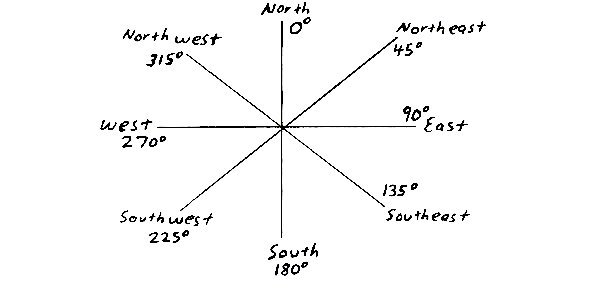
Cardinal Direction


Example: A man walks 30 m North and then 60 m West.
     a) What is the distance that he has traveled?
     b) What is his displacement ( Also state the direction he has moved from his starting point )?


Solve Graphically (more accurate if using graph paper):

     a) distance = 90 m
     b) displacement ~ 6.7 squares = 67 m, 26° + 270° = 296° bearing

Bearingis the angle measured in degrees in a clockwise direction from the north line. 


Solve Mathematically


a) distance = 30 + 60 = 90 m  
b) displacement => c^2 = a^2 + b^2 = 60^2 + 30^2, c = 67.08m
     
    (Soh-Cah-Toa), Tan Theta= 30/60, Theta = 26.56°  + 270°  = 296.56° bearing 


Concurrent forces: two or more forces which act on teh same point simultanously.


  • example - two people pull on ropes that are affected to a crate at the same time


Resultant: the net affect of two or more vectors acting on a point.
  • solve using the parallelogram method/technique
Example: Assume there are two forces acting on a point a 50N force acting due North, and a 70N force acting due wast. The resultant would be found by first drawing parallelogram. Next the length of the diagonal between the two force is calculated. Finally direction is determined.

  • Demonstration of Parallelogram


Example: One boy pull on a rope attached to a crate due North with a force of 250N. A second boy pulls on a rope attached to the same crate due West with a force of 140N. Find the resultant of the two forces acting on the crate.
     c^2 = a^2 + b^2 = 140^2 + 250^2
     c^2 = 82100, c^2 = 82100, c = 286.53 N

 (Soh-Cah-Toa), Tan Theta= 240/140
 Theta = 1.78 = 60.67°, 

 60.67° + 270° = 330.67° bearing 


Example: An airplane is trying to fly on a bearing of 90 degrees (due east) at a velocity of 250 Km/hr. A wind force due south velocity of 130 km/hr. What is the actual velocity of the plane?
     c^2 = a^2 + b^2 => 130^2 + 250^2
     c =  281.78 km/hr
     Cos Theta = 250/281.78 = 27.50°,
     27.50° + 90° = 117.5° bearing


Example: A river is flowing due south at a velocity of 12 m/s. A boat is attempting to across this same river by traveling at a velocity of 25 m/s due west. The river is 250 m wide. 
     a) What is the velocity of the boat? (include direction)
     b) How long does it take the boat to across the river?
     c) How far down the stream is the boat by the time it reaches the opposite bank?
     a) c^2 = 25^2 + 12^2, c = 27.7 m/s
         Tan Theta = 25/12, Theta = 64.35°,
          64.35° + 180° = 244.45° bearing
     
     b) s = d/t, t = 250/25, t = 10 s

     c) d = 12 * 10 = 120 m 


Equilibrium: a state that exists when all forces cancel out.
  • vector sum of all the forces equals zero
  • a force which cancels out the resultant is called the equilibrant.

Monday, November 12, 2012

Friction


  • Is the force which opposes the motion of two objects or surfaces that are in contact with each other
  • Fore example, a box sitting on a floor. The force holding the surfaces together is called the Normal force.
  • The Normal force is defined as the force which acts perpendicular to the contact surface.


                                                   Fgravity = w = Fn

  • The amount of frictional force is determined by the amount of force holding the two surfaces together. It is also determined by the roughness of the two surfaces.
Identifying forces: If the box moves across the floor at a constant speed, the forces acting on it are balanced.

  • Frictional force = Ff, this force oppose the motion of the box
  • Normal force = Fn, this hold the contact surface together. It is perpendicular to the contact surfaces.
  • Applied force = Fa, is the force moving the box across the floor.

Coefficient of friction
  • Is a constant for any two surfaces in contact with each other
  • It is number determined by the roughness of the surfaces.
  • The rougher the surfaces are, the higher the coefficient of friction.
  • It is calculated using this formula: μ = Ff / Fn
  • μ (mu) is the coefficient of friction, it is unitless
  • Ff is the force of friction
  • Fn is the normal forces
Example: A box of 15kg being pushed forward at a constant speed. The applied force is 50 N. What is the coefficient of friction?

     Fn = w = mg = 15kg (9.8 m/s^2) = 147 N
     Ff = Fa, μ = Ff/Fn = 50 N/ 147 N = 0.34

Wednesday, November 7, 2012

Newton's Third Law of Motion


For every action , there is an equal and opposite reactions.

Example 1: Rocket


Example 2: Walking forward


Example 2: Sitting on a chair


-----------------------------------------
Next related topic: Friction

Sunday, November 4, 2012

Newton's Second Law of Motion


  • F= ma (Force = mass * acceleration)
  • A force is defined as a pushed or pull
  • In the metric system, force is measured in Newtons (N).
  • A newton is approximately equal to 1/4 lb (pound)
  • In physics, mass is usually measured in kilograms
  • Acceleration is measured in m/s^2
Example 1: A rocket of mas 1750 kg fires it engines in spaces. The engine exert of force of 4500 N. 
     a) At what rate will the rocket accelerate?

     F = ma => 4500 N = 1750 kg * a, solve for a,
     a = 4500/1750 = 2.57 N/g = 2.57 m/s^2

     b) How fast will the rocket be moving at the end of 25 s?
     
     Sf = si + at => Sf= 0 + (2.57 m/s^2) (25s) = 64.25 m/s

Example 2: Two forces act on a box. One force is 500 N and acts to the right. The second force is 840 N, and act to the left.

      a) What is the net force acting on the box?

     Fnet = Fa - Ff  = 840 -500 = 340 N left

    b) If the box mass is 120 kg, at what rate does it accelerate?

     F = ma => 340 N = (120 kg) a, a = 2.83 N/kg  or m/s^2


Weight:
  • Weight refers to the force of gravity acting on an object
  • The formula for calculating the weight of an object is a variation of Newton's 2nd Law.
  • W= mg (Weight = mass * gravitational acceleration (9.8 m/s^2))
  • Remember, mass is the amount of matter contained within an object. If you shoot a heavy object into space. Its weight will disappear, but its mass will be unchanged.
Example 1: An object has a mass of 320 kg. How much does this object weight?
     
     W = mg = 320 kg (9.8 m/s^2) = 3136 N

Example 2: A man weight 850 N. What is his mass?

     W = mg => 850 N = m (9.8 m/s^2), m = 86.7 kg

Example 3
 a) A man stands on a scale in an elevator. The elevator is not moving. The man's mass is 75 kg. What is the reading on the scale?
     W = mg = 75(9.8) = 735 N

b) If the elevator beginning to move upward 2 m/s^2. What is the reading on the scale now?

     F = ma = 75 kg ( 2 m/s^2) = 150 N
     Fnet = 735 N + 150 N = 885 N

c) The elevator come to stop and then start accelerating downward at 3 m/s^2. What is the reading on the scale now?

     F = ma = 75 (3) = 225 N
     Fnet = 735 - 225 = 510N